Hypodermic needle theory


The Hypodermic Needle Theory was one of the
earliest ways of thinking about how the mass media influences audiences.
It was developed in the 1920s and 1930s after
researchers observed the effect of propaganda during World War I. The
Hypodermic Needle Theory is a linear communication theory which suggests that
media messages are injected directly into the brains of a passive audience. It
suggests that we’re all the same and we all respond to media messages in the
same way.
This technique was used more and more since the war
as it is such an effective way to try and sway people into thinking in
particular ways.
·
We believe that this theory does not apply to our
audience as they are not passive. We try to sway them into thinking into a
particular way by feeding them stereotypical codes and conventions of a
romantic comedy like our characters in our characters traits in our film, but
they all respond to our media texts in different ways.
The Effects
Theory
Similar to the Hypodermic needle effect, the
Effects theory was developed in the 1920’s, and looks at how media texts
influence those who consume them, particularly (in recent decades) how negative
messages, e.g. sexual and violent content, can affect the most vulnerable of
audience groups.
·
Our film, Footsteps and Tyre tracks will positively
influence our audiences as they see our characters go on their emotional
journeys together, allowing audiences to understand and sympathise with out
characters. Our production will have no
negative messages which will affect our audiences as there is no sexual or
violent content which may upset or offend our viewers.
Two step
flow theory
The theory suggests that the information given
through media texts doesn't flow directly from the text into minds of its
audience which is unmediated. Information is filtered through opinion leaders
and then it is communicated towards us through the media from the opinion
leaders. The theory suggests that in 1940 Paul Lazarsfeld, Bernard Berclson and
Hazel Gaudat conducted first full scale investigations of mass communications.
The two step flow suggests that information
doesn't flow from the media text straight to the audience but, within that
cycle, other people tend to have point of views that affect the audience.
Certain people have a large influence on how people gain opinions about
specific media texts like films, instead of the actual film giving them a
related opinion once they have gathered one from what they've been told.

The uses and
gratifications theory
During the 1960s, as the first generation to grow
up with television became grownups, it became increasingly apparent to media
theorists that audiences made choices about what they did when consuming texts.
Audiences were made up of individuals who actively
consumed texts for different reasons and in different ways. In 1948 Lasswell
suggested that media texts had the following functions for individuals and
society:
· Surveillance
· Correlation
· Entertainment
· Cultural transmission
Researches Blumler and Katz developed their
own theory in 1974, saying that individuals might choose and use text for the
following purposes:
· Diversion - escape from everyday
problems and routine
· Personal Relationships - using
the media for emotional and other interaction, e.g. substituting soap operas
for family life
· Personal Identity - finding
yourself reflected in texts, learning behaviour and values from texts
· Surveillance - Information which
could be useful for living like weather reports and financial news
·
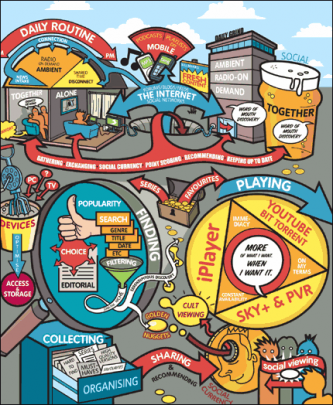
Our audience for our film would watch our film for
a number of functions, like entertainment, personal relationships and personal
identity. We believe that our audiences would watch our film for escapism from
daily life. They would sit down with friends and family to watch our film, to
relax and escape from the stresses of day to day life.


No comments:
Post a Comment